
Beha-Amprobe 2100-Delta Manual
PDF manual · 207 Pages
English


Quick check
Incorrect answer, please try again.
Chat with your Beha-Amprobe 2100-Delta manual using AI
Get instant AI answers from your Beha-Amprobe 2100-Delta manual
Ask anything about the Beha-Amprobe 2100-Delta. Answers come from this manual, with the pages they are based on.
2100-Delta Maintenance Schedule
Test the voltage tester on a known voltage source or proving unit before and after every use to ensure perfect working condition.
Replace batteries when the LCD starts blinking low battery symbol or if they leak. Remove batteries if not used for a prolonged period.
Clean with a damp cloth and mild detergent if dirty. Do not use aggressive detergents. Ensure completely dry before use.
Ask a Question
Do you recommend 2100-Delta?
Yes NoFrequently Asked Questions
The 2100‑Delta measures AC from 1 V to 1000 V (15–800 Hz) and DC from 1 V to 1500 V. It also has a special “<10V” mode for accurate low‑voltage readings down to 1 V.
Is this answer helpful?
The integrated open jaw measures AC TRMS currents from 0.1 A to 200.0 A with 0.1 A resolution. For best accuracy place the conductor centered in the jaw at the marked zone; max conductor diameter is ~13 mm.
Is this answer helpful?
Yes. The unit is rated CAT IV 600 V and CAT III 1000 V and meets relevant IEC/EN standards. Always follow two‑pole verification procedures and site safety protocols when working on high‑energy systems.
Is this answer helpful?
The tester includes a white LED measurement flashlight and LCD backlight for dark conditions, a vibration motor and audible buzzer for voltage thresholds (≥50 VAC, ≥120 VDC), and clear LED indicators for visual confirmation.
Is this answer helpful?
No. The EF/cable‑break detector is for locating faults and live conductors; it is not a substitute for a two‑pole voltage test. Always use two‑pole voltage measurement to prove absence of voltage.
Is this answer helpful?
Powered by two AAA (IEC LR03) batteries, the tester supports more than 10,000 quick measurements. Replace batteries via the screw‑closed compartment; a self‑test runs after replacement and low‑battery is indicated on the LCD.
Is this answer helpful?
Routine cleaning with a damp cloth is sufficient. For malfunctions beyond battery replacement, return the unit to an authorized Beha‑Amprobe service center. Avoid using the device if functions fail or if damage is evident.
Is this answer helpful?
Advantages and Disadvantages
Advantages

- Wide measurement scope: TRMS voltage (1–1000 VAC, 1–1500 VDC), 0.1–200 A current clamp, frequency, resistance, diode, continuity and EF detection.
- High safety and compliance: CAT IV 600 V / CAT III 1000 V, IEC/EN standards, IP64 dust and splash protection.
- Practical field features: LED/LCD indicators, flashlight/backlight, vibration alarm, auto power on/off, data hold and self‑test.
- User convenience: Probe storage, protective caps, 4 mm extensions, UK socket opener and holster included.
- Long battery life and clear low‑battery indication; ELV LED works without batteries for basic detection.
Disadvantages

- Two‑pole testing remains required to prove absence of voltage; single‑pole and EF modes are not substitutes for safety verification.
- Some advanced repairs require authorized service centers; only battery replacement is user‑serviceable.
- Display and non‑contact functions can be impaired by insulating PPE or certain grounding/insulation conditions.
- Continuity and resistance accuracy limited at extremes; continuity thresholds and tolerances can vary with conditions.
- Auto shutoff may interrupt extended hands‑free tests unless reactivated or disabled by user workflow.
Product Specification
Measurement Range
1-1,000V
Product Description
Beha-Amprobe 2100-Delta Spannungsprüfer — Powerful, Safe, and Versatile Voltage Tester
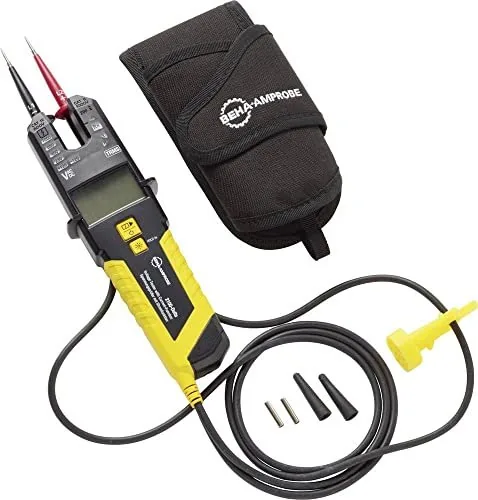
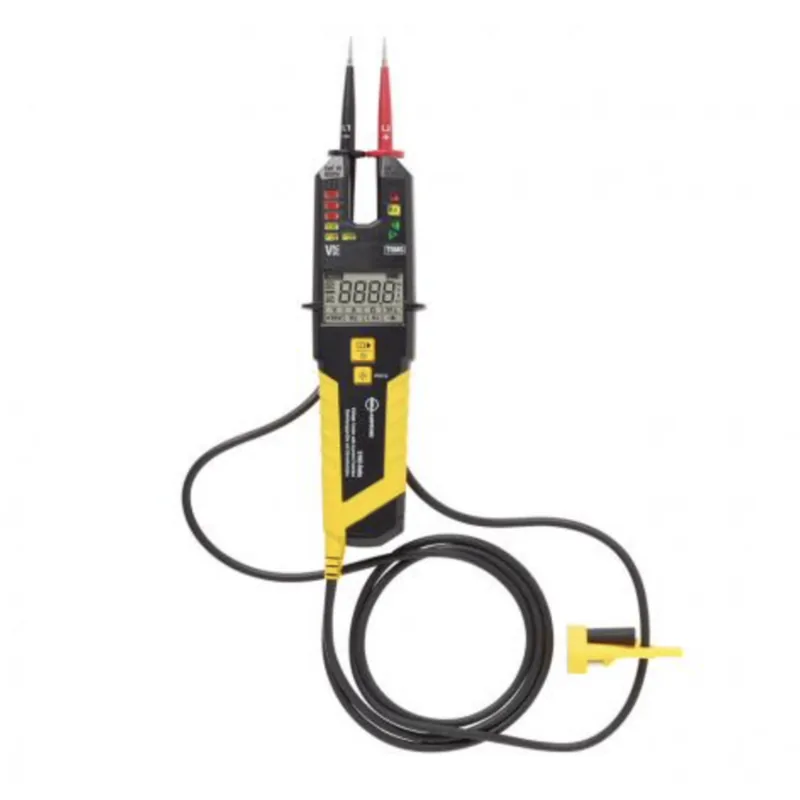
The Beha-Amprobe 2100-Delta is a rugged two‑pole voltage tester engineered for electricians working in residential, commercial, and industrial environments. Combining TRMS voltage measurement, an open‑jaw current clamp, and a suite of diagnostic features, it covers common on‑site tasks with an emphasis on safety and ease of use. With a wide voltage range (1 V to 1000 VAC and up to 1500 V DC), automatic AC/DC detection, tactile vibration alerts, LED/LCD indicators and a bright flashlight/backlight, the 2100‑Delta streamlines troubleshooting in dimly lit control cabinets, panels, and field conditions.
The instrument’s safety credentials are strong: IEC/EN compliance to voltage tester and clamp standards, CAT IV 600 V / CAT III 1000 V overvoltage ratings, and IP64 dust/splash protection. It supports two‑pole voltage testing as the primary absence‑of‑voltage method, while single‑pole phase detection and a non‑contact electric‑field (EF) cable break detector help quickly locate live conductors and faults. The built‑in open clamp measures AC currents up to 200 A TRMS with 0.1 A resolution; the jaw accepts conductors up to ~13 mm.
Beyond voltage and current, the 2100‑Delta includes continuity and resistance modes (with a low‑resistance L Rx <20 Ω feature), diode testing, frequency measurement (1–800 Hz), and a dedicated low‑voltage “<10V” mode for sensitive checks down to 1 V. A two‑probe phase rotation function provides left/right rotation indication between phases without a third hand. Data Hold, auto power‑on/off, self‑test on battery change, and protection cap/extension storage all boost practical usability.
Designed for field reliability, the unit runs on two AAA batteries, offers more than 10,000 quick measurements per battery set, and warns of low battery via the display. Maintenance is minimal — battery replacement is user‑serviceable while other repairs should be handled by authorized service centers. The 2100‑Delta ships with probe protective caps, 4 mm extensions, a holster, and built‑in probe storage and tools (e.g., UK socket opener) for safer, convenient field work.
Notes:
- Always perform a two‑pole voltage test to verify absence of voltage; single‑pole tests and EF detection are supplementary and not substitutes for proving dead circuits.
- The device includes both audible and vibro tactile alarms above set thresholds (≥50 VAC, ≥120 VDC) — verify audibility in noisy environments.
- For accurate clamp measurements, center the conductor in the jaw at the marked zone.
Search for 67,706 Manuals online


Type-in Brand or Model
gbrzezinski85
9 months ago
How accurate is the voltage detection when using the E-field (non-contact) function, and will it miss live wires compared to a contact tester?
Manual.ly
9 months ago
The E-field voltage detection is intended as a quick indication, so it is naturally less precise than contact measurement with the probe tips. If you need reliable confirmation, use a contact test on the live point with the metal tips (and verify with a known source when required by your procedure). The tester provides a hazardous-voltage warning with multiple LED indications plus audible and vibration signals. For safety-critical work, rely on the contact measurement modes rather than the E-field function alone.