
BASF Ultrafuse TPU Manual
PDF manual · 2 Pages
English



Quick check
Incorrect answer, please try again.
Chat with your BASF Ultrafuse TPU manual using AI
Get instant AI answers from your BASF Ultrafuse TPU manual
Ask anything about the BASF Ultrafuse TPU. Answers come from this manual, with the pages they are based on.
Ask a Question
Do you recommend Ultrafuse TPU?
Yes NoFrequently Asked Questions
It is used for flexible, durable 3D printed parts that need wear resistance, damping, and elastic recovery. Common examples include shoe soles, watch bands, grips, and protective components.
Is this answer helpful?
Unlike rigid materials, TPU 85A bends and absorbs impact instead of cracking easily. It is designed for movement, comfort, and repeated stress rather than structural stiffness.
Is this answer helpful?
The text recommends a nozzle temperature of 200–220 °C, a bed temperature of about 40 °C, a nozzle diameter of at least 0.4 mm, and a print speed of 15–40 mm/s.
Is this answer helpful?
Yes. One of its key advantages is very good flexibility at low temperatures, which helps it remain useful in colder conditions where some materials become brittle.
Is this answer helpful?
Yes. Its resistance to wear, oils, greases, ozone, and microbial attack makes it suitable for industrial, automotive, agricultural, and construction-related parts.
Is this answer helpful?
TPU 85A is the flexible, damping-focused option, while Ultrafuse PA is more rigid and better for strong, stiff parts. The choice depends on whether flexibility or stiffness matters more.
Is this answer helpful?
Advantages and Disadvantages
Advantages

- High wear and abrasion resistance for parts exposed to constant rubbing or contact.
- Excellent damping and tear resistance, making it ideal for shock-absorbing designs.
- Very good low-temperature flexibility for outdoor or demanding use.
- Resists oils, greases, oxygen, ozone, and microbial attack.
- Printable on many FFF systems with moderate temperatures and a 0.4 mm nozzle or larger.
Disadvantages

- Prints more slowly than many standard filaments, with recommended speeds of 15–40 mm/s.
- Not the best choice when a rigid, high-stiffness part is required.
- Flexible material behavior can demand careful tuning of temperature and speed.
- Fine details may be harder to achieve compared with less elastic filaments.
Product Specification
Packaging
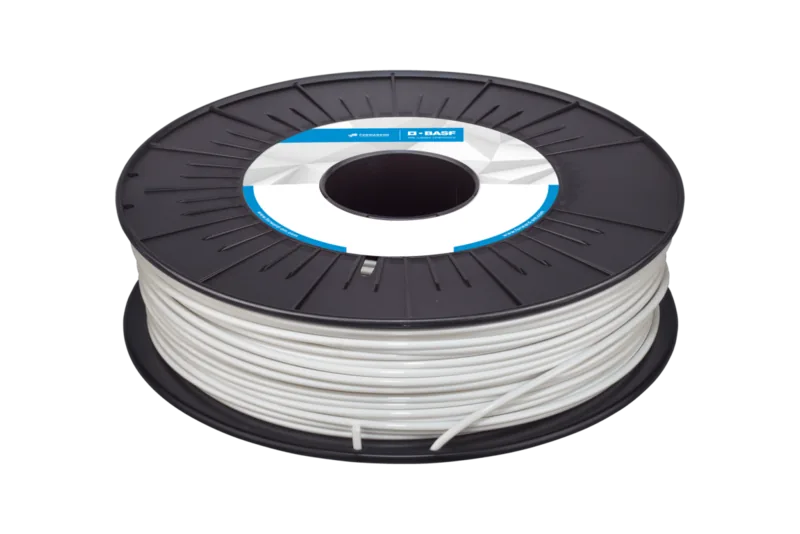
Filament Spool
Type
TPU
Weight
1.65 lb
Features
flexible
Product Description
BASF Ultrafuse Ultrafuse TPU 3D Printing Filament Manual
BASF Ultrafuse TPU 85A is a flexible FFF filament built on BASF’s Elastollan® TPU platform. It is designed for makers and engineers who need parts that can bend, absorb impact, and keep performing under repeated stress. For anyone looking for a BASF Ultrafuse Ultrafuse TPU 3D printing filament Manual, this material is a practical example of how flexible printing can still deliver dependable strength.
What makes this filament appealing is its balance of toughness and comfort in use. It offers high wear resistance, strong tear resistance, excellent damping behavior, and very good flexibility at low temperatures. That combination makes it a smart choice for parts that see constant movement or contact, such as shoe soles, watch bands, protective covers, grips, and soft functional components.
The material also performs well in demanding environments. Its resistance to oils, greases, oxygen, ozone, and microbiological attack expands its usefulness beyond hobby projects and into industrial settings. From sports and leisure products to automotive, agriculture, construction, and general manufacturing, TPU 85A supports applications where durability and flexibility need to work together.
Printing with Ultrafuse TPU 85A is relatively straightforward when the settings are tuned correctly. Recommended parameters include a nozzle temperature of 200–220 °C, a bed temperature around 40 °C, a nozzle diameter of at least 0.4 mm, and a print speed of 15–40 mm/s. A glass bed is sufficient for preparation, which keeps the workflow accessible on many FFF printers.
Compared with stiffer BASF materials such as Ultrafuse PA, TPU 85A is the better option when shock absorption, softness, and elastic recovery matter more than rigidity. It is especially useful for customized designs where the final part must move, flex, or cushion repeated force without cracking.
Notes
- Best suited for flexible and impact-resistant parts.
- Slow, steady printing usually improves consistency.
- Ideal for customized products where comfort and durability matter.
Search for 67,706 Manuals online


Type-in Brand or Model