
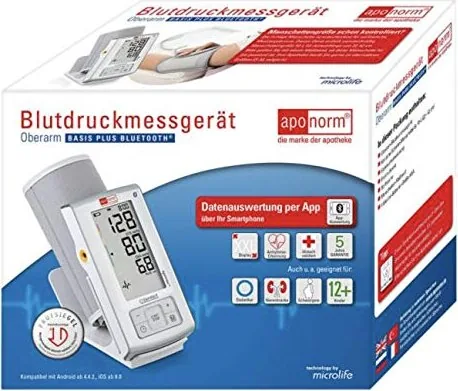

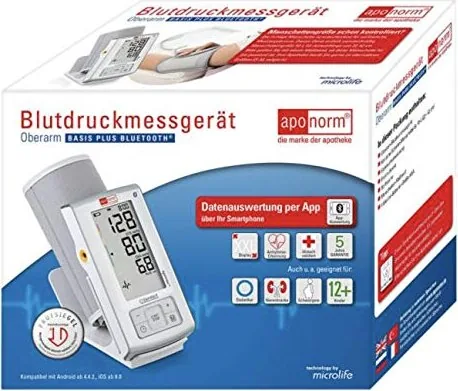
aponorm Basis Plus Manual
PDF manual · 17 Pages
English



Quick check
Incorrect answer, please try again.
Chat with your aponorm Basis Plus manual using AI
Get instant AI answers from your aponorm Basis Plus manual
Ask anything about the aponorm Basis Plus. Answers come from this manual, with the pages they are based on.
Ask a Question
Do you recommend Basis Plus?
Yes NoFrequently Asked Questions
Sit quietly for at least five minutes, support your arm at heart level, remove tight clothing, place the cuff 2–3 cm above the elbow crease with the artery marker aligned, avoid talking or moving, and repeat measurements with short pauses for reliable results.
Is this answer helpful?
The arrhythmia symbol indicates detected pulse irregularities during measurement. Repeat the measurement; if the symbol appears frequently (e.g., several times per week), show the readings to your physician for further evaluation. The device aids early detection but does not replace cardiological exams.
Is this answer helpful?
Choose the cuff size based on mid-upper-arm circumference: S 17–22 cm, M 22–32 cm, M-L 22–42 cm, L-XL 32–52 cm. Using the correct aponorm cuff ensures accurate inflation and measurement; avoid overly loose or tight placement.
Is this answer helpful?
The monitor stores up to 99 measurements. When full the oldest value is overwritten by new measurements. You can view stored results via the M button. To erase all entries hold the M button until 'CL' appears and confirm; individual entries cannot be deleted.
Is this answer helpful?
Power with four AAA batteries or the optional 6V DC, 600 mA adapter. Use fresh Longlife AAA cells or NiMH rechargeables (remove before charging, and remove from device if unused for a week) to prevent deep discharge and damage.
Is this answer helpful?
The color-coded bars indicate blood pressure categories per international guidelines: green (normal), yellow (borderline), orange (high), red (dangerously high). Use them as quick guidance and consult a physician for concerning levels.
Is this answer helpful?
Error codes indicate measurement issues (e.g., insufficient cuff pressure, movement artifacts). Reposition the cuff, remain still, check connections and battery level, and repeat the measurement. If errors persist, contact customer service or your physician.
Is this answer helpful?
Advantages and Disadvantages
Advantages

- Clinically validated oscillometric measurement with Korotkoff method correlation for reliable home readings.
- Arrhythmia indicator and color-coded traffic-light display simplify interpretation and early detection of irregularities.
- Large memory capacity stores up to 99 measurements for trend review; automatic overwrite preserves recent data.
- Automatic cuff inflation and one-button operation make measurements quick and easy for most users.
- Several cuff sizes and optional mains adapter (6V DC) provide flexibility for varied users and reduce battery dependency.
Disadvantages

- Requires correct cuff size and positioning—incorrect fit can produce inaccurate readings.
- DCF77 automatic time setting may fail in some locations, requiring manual time configuration.
- Motion, talking, or muscle tension during measurement can cause errors or invalid results.
- Rechargeable batteries must be removed for charging and if left in device can suffer deep discharge damage.
- Single-measurement deletion is not possible; memory can only be fully cleared, which may be inconvenient.
Product Specification
Operating Mode
Battery operated (4x AA battery)
Measurement Type
Upper arm, fully automatic
Cuff Circumference
8.66-16.54 in
Analysis Data
Systole, Diastole, Pulse, Arrhythmia detection, Risk indicator
Memory Function
99 memory slots
Display
yes
Special Features
Date display, Time display, Average value display, Automatic shutdown
Scope of delivery
Bag, Blood pressure pass, Stand
Product Description
aponorm Basis Plus — Reliable Upper-Arm Blood Pressure Monitor
The aponorm Basis Plus is a user-friendly, clinically validated upper-arm blood pressure monitor designed for home use. Developed in collaboration with physicians and tested for accuracy, it offers clear digital readings of systolic and diastolic pressure plus pulse rate. The device supports multiple cuff sizes, automatic inflation, and stores up to 99 measurements for trend monitoring. It includes helpful features such as an arrhythmia indicator for early pulse irregularity detection, a color-coded "traffic light" display to quickly classify results, and an optional mains adapter to avoid battery use.
Key features and how it helps
The monitor is straightforward to set up: insert four AAA batteries (or use the optional 6V DC adapter), attach the correct cuff for your arm circumference, and the device automatically adjusts time using the DCF77 radio signal (or allows manual time setting). Measurement is automatic with a single Start/Stop button; the cuff inflates and the device displays systolic, diastolic, and pulse values. During measurement it warns of motion artifacts and displays error codes to help troubleshoot.
Clinical-grade oscillometric measurement correlates to Korotkoff-based standards and the product documentation recommends measuring in rest conditions twice daily for consistent tracking. The arrhythmia detection alerts users and clinicians to pulse irregularities that may warrant further evaluation. The memory function saves up to 99 readings and automatically overwrites the oldest entry when full. A clear battery indicator, washable cuff maintenance guidelines, and a five-year warranty add practical reassurance.
Practical usage tips
- Sit relaxed for five minutes before measuring, keep the arm supported at heart level, and avoid talking, eating, or smoking during measurement.
- Use the correct cuff size (S:17–22 cm, M:22–32 cm, M-L:22–42 cm, L-XL:32–52 cm) and align the cuff artery marker over the inner arm artery about 2–3 cm above the elbow crease.
- Repeat measurements after short pauses for reliable averages and consult a physician for abnormal or frequently irregular readings.
Notes
- The device is intended for home self-monitoring and does not replace medical diagnosis.
- Clean the unit with a soft dry cloth; do not machine-wash the cuff. Battery removal is recommended if stored unused for long periods.
- Follow local disposal regulations for batteries and electronic waste.
Search for 67,706 Manuals online


Type-in Brand or Model