Manual.ly Logo

AMIGO Bohnanza Manual

0.0 · 0 Ratings

PDF manual · 2 Pages

English

M: OA-GPT-54-NAN
page

/ 2

Loading...
3390537753d6ac1b9b94b8aa69934f1fb804 page 1
The Idea of The Game
Bohnanza is all about planting, trading, and harvesting beans. Trade beans with the other
players and plant them in your fields. That’s great fun! And the more beans you have in your
field, the more bean dollars you get when you harvest them. If you have the most bean dollars
at the end of the game, you win!
ConTenTs & seTup
Give one of the bean field mats to each player. These mats have one side showing three bean
fields and one side showing two fields:
If there are three players, use the mats with the three
bean fields side up.
If there are four or five players, start with two bean
fields each.
Pick a starting player and give him or her the starting player card. (The
second starting player card is a replacement card if you need it—you
can keep it in the box.)
There are 104 cards showing 8 different kinds of beans. The large
number printed on each card tells you how many cards with this kind
of bean are in the game.
Shuffle all the cards and deal five cards to each player.
Attention! This is the
most important rule of
the whole game!
You cannot change the
order of the cards in your
hand at any point during
the game! The first card
you are dealt is the first
card in your hand. It’s completely visible to
you. Put all other cards you receive behind
it, in the order drawn. You may never sort
your cards by bean or for any other reason.
Put the remaining cards in the center of the
table as a draw pile, dollar side up. During the
game, you will create a discard pile next to it
and a dollar pile in front of each player (see
illustration to the right).
playInG The Game
The starting player is the first active player. After that, players take turns going to the left.
Note: Don’t pass the starting player card. It stays with the starting player for the whole game
(see
“The End of the Game”
).
When it is your turn, you play through these four phases in order:
1. Plant Bean Cards from Your Hand
2. Turn Over and Trade Bean Cards
3. Plant Turned-over and Traded Bean Cards
4. Draw Bean Cards
Important Rules for Planting Beans:
You can only plant one kind of bean in each field at a time. You are allowed to
plant the same kind of bean in two different fields at the same time, but not
two kinds of bean in the same field. Put the bean cards in your field on top of
each other, as shown to the left.
Phase 1: Plant Bean Cards from Your Hand
You must plant the first
card in your hand (i.e. the
one that is completely visi-
ble) in one of your fields
(see illustration to the right).
After that, you may choose
to plant one more card –
the one that is now com-
pletely visible – in one of
your fields (see illustrati-
on to the right). You can’t
plant a third bean.
When planting, you start or extend the column of cards in the field.
If you have to plant a kind of bean you don’t have space for, you must harvest a field
first (see
“Harvesting Beans”
).
If you don’t have any cards in your hand at the start of phase 1, skip it and go straight
to phase 2.
Phase 2: Turn Over and Trade Bean Cards
Turn over the top two cards from the draw pile and put them next to it
face-up for all players to see.
The turned-over cards belong to you: You can plant them in your fields or
use them to trade with the other players.
Example #1: Timon has turned over a Soy Bean and a Blue Bean. He keeps
the Blue Bean, but there is no space for the Soy Bean in his bean fields, so
he offers it up for trade to the other players. He asks: “Would anyone like
this Soy Bean? I’d like to trade it for a Red Bean.”
“To Bean or noT To Bean!”
by Uwe Rosenberg, with illustrations by Björn Pertoft
Players: 3–5 • Ages: 10 and up • Duration: approx. 45 minutes
amigo-spiele.de/01661
10
2 4 5 6
Augenbohne
2 4 6 7
Sojabohne
12
2 3
Gartenbohne
6
2 3 4 5
Rote Bohne
8
3 6 8 9
Feuerbohne
18
20
4 6 8 10
Blaue Bohne
3 5 6 7
BrechBohne
14
3 5 7 8
Saubohne
16
6x 8x 10x 12x 14x 16x 18x 20x
20
4 6 8 10
Blaue Bohne
Starting Player Card
20
4 6 8 10
Blaue Bohne
2 4 6 7
Sojabohne
12
Bohnenfelder_160428.indd 1 02.05.16 09:02
20
4 6 8 10
Blaue Bohne
2 3 4 5
Rote Bohne
8
3 5 7 8
S
aubohne
16
3 6 8 9
F
euerbohne
18
2 3
Gartenbohne
6
20
4 6 8 10
B
laue
B
ohne
First Card
Bohnenfelder_160428.indd 2 02.05.16 09:02
For 3 players
Bohnenfelder_160428.indd 1 02.05.16 09:02
For 4-5 players
Draw
Pile
Discard
Pile
2 3
G
artenbohne
6
2 4 6 7
S
ojabohne
12
2 4 6 7
S
ojabohne
12
3 6 8 9
F
euerbohne
18
2 4 6 7
S
ojabohne
12
Dollar
Pile
3 5 7 8
S
aubohne
16
20
4 6 8 10
B
laue
B
ohne
2 3
G
artenbohne
6
2 3 4 5
R
ote
B
ohne
8
20
4 6 8 10
B
laue
B
ohne
Dollar
Pile
3 5 6 7
B
rechBohne
14
3 5 7 8
S
aubohne
16
2 4 6 7
S
ojabohne
12
3 5 6 7
B
rechBohne
14
3 5 6 7
B
rechBohne
14
Dollar
Pile
10
2 4 5 6
A
ugenbohne
20
4 6 8 10
B
laue
B
ohne
3 5 6 7
B
rechBohne
14
3 5 6 7
B
rechBohne
14
3 6 8 9
F
euerbohne
18
Dollar
Pile
Timon
Nina
Keno
Eiko
Bohnenfelder_160428.indd 1
02.05.16 09:02
Bohnenfelder_160428.indd 1
02.05.16 09:02
Bohnenfelder_160428.indd 1
02.05.16 09:02
Bohnenfelder_160428.indd 1
02.05.16 09:02
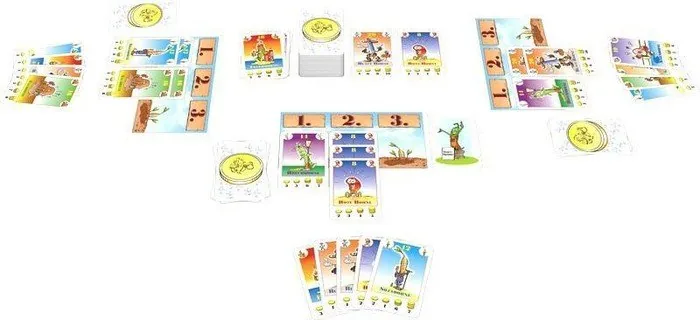
The layout at the start of a four-player game
Bohnenfelder_160428.indd 1 02.05.16 09:02
3 5 7 8
Saubohne
16
3 5 7 8
Saubohne
16
3 5 7 8
Saubohne
16
3 6 8 9
Feuerbohne
18
3 6 8 9
Feuerbohne
18
3 6 8 9
Feuerbohne
18
3 6 8 9
Feuerbohne
18
3 5 7 8
S
aubohne
16
3 6 8 9
F
euerbohne
18
2 3
Gartenbohne
6
2 3 4 5
R
ote
B
ohne
8
20
4 6 8 10
B
laue
B
ohne
Bohnenfelder_160428.indd 1 02.05.16 09:02
20
4 6 8 10
Blaue Bohne
3 5 7 8
S
aubohne
16
3 6 8 9
F
euerbohne
18
2 3
Gartenbohne
6
2 3 4 5
R
ote
B
ohne
8
Bohnenfelder_160428.indd 1 02.05.16 09:02
20
4 6 8 10
Blaue Bohne
2 3 4 5
Rote Bohne
8
3 5 6 7
B
rechBohne
14
3 5 7 8
S
aubohne
16
2 4 6 7
Sojabohne
12
3 5 6 7
B
rechBohne
14
Bohnenfelder_160428.indd 1 02.05.16 09:02
3 5 6 7
BrechBohne
14
3 5 6 7
BrechBohne
14
3 5 6 7
B
rechBohne
14
3 5 7 8
S
aubohne
16
2 4 6 7
Sojabohne
12
3 5 6 7
B
rechBohne
14
3 5 6 7
B
rechBohne
14
Bohnenfelder_160428.indd 1 02.05.16 09:02
3 5 6 7
BrechBohne
14

Chat with your AMIGO Bohnanza manual using AI

Get instant AI answers from your AMIGO Bohnanza manual

Ask anything about the AMIGO Bohnanza. Answers come from this manual, with the pages they are based on.

Ask a Question

0/1000

Do you recommend Bohnanza?

Yes No

Frequently Asked Questions

A

It describes a bean-trading card game focused on planting, trading, and harvesting beans for the highest number of bean dollars. The core fun comes from negotiating with other players and managing field space wisely.

Is this answer helpful?

A

Cards must stay in the exact order they were drawn. You may only use the first visible card, and later cards must remain behind it. This rule makes every draw and trade more tactical.

Is this answer helpful?

A

Only the active player can trade during their turn. Other players cannot trade among themselves, but they can agree or refuse any deal offered to them.

Is this answer helpful?

A

Harvesting converts bean fields into bean dollars, which decide the winner. Since different beans pay out differently, players must choose the best moment to collect and free up field space.

Is this answer helpful?

A

When the draw pile is empty, the discard pile is reshuffled and used again. The game ends after the draw pile is exhausted for the third time, then all fields are harvested for final scoring.

Is this answer helpful?

A

Its mix of open trading, strict hand order, and bean field management creates a unique balance of luck, planning, and social strategy. It is especially fun in groups that enjoy talking and negotiating.

Is this answer helpful?

M: OA-GPT-54-NAN

Advantages and Disadvantages

Advantages

  • Highly social gameplay with constant negotiation and player interaction.
  • Simple rules create a quick learning curve for new players.
  • The fixed hand order adds a clever strategic twist.
  • Harvest timing and field management create meaningful decisions.
VS

Disadvantages

  • Trading depends on the group, so pacing can vary.
  • Players who dislike bargaining may find it stressful.
  • Limited hand control can feel restrictive at first.
  • Scoring and bean values can take a few plays to fully absorb.
M: OA-GPT-54-NAN

Product Specification

Type

Card Game

Genre

Strategy

Players

3 to 5

Playtime

45 min

Recommended Age

from 10 years

Author

Uwe Rosenberg

Publisher

Amigo

M: OA-GPT-54-NAN

Product Description

Bohnanza Relaunch Manual

The Bohnanza Relaunch Manual captures the playful spirit of a fast-moving bean trading game where timing, negotiation, and planning matter just as much as luck. At its core, the game is about growing valuable crops, but every turn adds a layer of social strategy. Players plant beans, bargain with opponents, and harvest at the right moment to turn their fields into bean dollars. The result is a lively tabletop experience that rewards conversation, quick decisions, and a sharp eye for value.

One of the most distinctive ideas in Bohnanza is the hand order rule. Cards must stay in the exact order they were drawn, which creates constant tension and forces players to work with what is immediately available. That small restriction shapes the entire game: you cannot simply sort for the best option, so every trade and every planting decision feels important. The game also encourages flexible thinking, since each field can hold only one bean type at a time and planting the wrong crop may require a harvest first.

Trading is where the game truly shines. The active player can negotiate with everyone at the table, offering hand cards and face-up cards for better deals. This open trading system keeps all players involved and makes every turn feel social and unpredictable. Sometimes a single bean is enough to complete a field; other times players must bundle several cards together to make a deal happen. Because trades are voluntary, every agreement feels earned, and that gives the game a satisfying mix of bluffing, persuasion, and compromise.

Harvesting adds a smart economic layer. Each bean type has its own payout scale, so players must decide whether to cash out early or wait for a bigger return. This makes field management feel meaningful throughout the game, especially when space is tight and a new bean must be planted quickly. The endgame also keeps pressure high, since the final score depends on total bean dollars after the draw pile is exhausted multiple times.

Overall, Bohnanza is a cheerful, interactive card game that blends resource management with table talk in a memorable way. It is easy to explain, yet full of small tactical choices that keep it fresh across repeated plays. For groups that enjoy negotiation and light strategy, it remains a standout classic.

Notes

  • Best for groups that enjoy constant interaction.
  • Trading is the heart of the experience.
  • Planning ahead matters, but flexibility matters more.
  • A simple setup hides a surprisingly clever system.
M: OA-GPT-54-NAN

© Copyright 2026 Manual.ly