Manual.ly Logo

AMIGO Bohnanza The Duel Manual

0.0 · 0 Ratings

PDF manual · 2 Pages

English

M: QW-35-FL
page

/ 2

Loading...
75f2ec667639070e0dd902dc5b8f97a16e57 page 1
The Idea of The Game
This Bohnanza duel between you and your opponent is all about planting, trading, and harvesting beans—trading sneaky
gifts that don’t always come straight from the heart, that is. It’s your goal to earn as many bean dollars as you can. Bo(h)
nus cards give you extra dollars if beans get planted in a certain order. If you have the most bean dollars at the end of
the game, you win!
ConTenTs and seTup
Take one bean field mat each and put them in front of you. You will have three fields to plant your
beans in during the game.
Shuffle the 32 bo(h)nus cards and put them in a face-down pile in the center of the table. During
the course of the game, a discard pile will be created next to it.
Place the eight gift cards in a face-up row (in ascending order according to their numbers).
Start with the first card to the right of the bo(h)nus card pile.
There are 104 bean cards of eight different types. The numbers in the corners of each bean card tell
you how many beans of this type there are in the game. Bean cards show bean dollars on the back.
Shuffle all the bean cards then count off
six of them without looking at them.
Each player gets three of these and puts
them in a pile in front of themselves with
the dollar side showing. This is the start
of your dollar piles. Put the remaining
bean cards in a draw pile, dollar side up,
to the right of the eighth gift card. During
the course of the game, you will create a
discard pile next to it (see illustration to
the right).
Take turns drawing five bean cards one
after the other. Put them in your hand, then
do the same with three bo(h)nus cards.
playInG The Game
Pick a starting player. This player is the first active player and carries out the following four phases:
1. Plant one or two bean cards from your hand
2. Turn over three bean cards and give away one bean card
3. Plant bean cards you’ve turned over and been given
4. Draw bean cards and bo(h)nus cards if possible
Phase 1: Plant one or two bean cards from your hand
You must plant the first bean card in your hand, i.e. the one
that is completely visible, in one of your fields (see illustration
to the right).
After that, you may choose to
plant another bean, the one that
is now completely visible, in any
one of your fields (see illustrati-
on to the right). You can’t plant
a third bean card in this phase.
By planting beans, you start or
expand the column of beans in
your field.
If you have to plant a kind of bean you don’t have space for, you’ll have to harvest a field first (see
“Harvesting Beans“
).
Phase 2: Turn over three bean cards and give away one bean card
Turn over the top three cards of the draw pile and put them in front of you.
Example 1: Uwe has turned over a Soy Bean, a Chili Bean, and a Blue Bean.
These cards are yours: You can plant them in your fields or try to give them to
your opponent.
Giving away beans using the gift cards
As the active player, you must offer one type of bean (one card) as a gift to your opponent.
This can either be one of the three cards you’ve turned over or one of the cards in your hand. You
can also try to bluff (see
“You can bluff”
, below).
Once you’ve decided which type of bean you would like to offer up as a gift, push the gift card
showing that bean type towards your opponent.
Example 2: Uwe pushes the Soy Bean gift card towards Susanne to show that he wants to give her
a Soy Bean.
Now, it’s up to your opponent: They can choose whether to accept your gift or not.
If they accept your gift, you must give them one bean card of the type you’ve indicated. They put it next to their bean
fields
horizontally
for now.
If they decline your gift, they now must offer a gift to you.
They push a different gift card towards you. Your opponent only has the cards in their hand to give you, but they
can
bluff.
Now it’s your turn to decide whether you want to accept this gift or not.
Example 3: Susanne doesn’t want the Soy Bean. She pushes a Blue Bean towards Uwe,
indicating that she wants to give him a Blue Bean.
“There can be only one!”
by Uwe Rosenberg, with illustrations by Björn Pertoft
Players: 2 • Ages: 12 and up • Duration: about 45 minutes
amigo-spiele.de/01658
6x 8x 10x 12x 14x 16x 18x 20x
Bohnenfelder_Duell_160520.indd 1 20.05.16 08:12
First card
Attention! This is the most important rule of the whole game:
You can’t change the order of the bean cards in your hand at any point during
the game. The first bean card you’ve drawn is the first card in your hand. It’s
completely visible. Put all other cards you receive behind it, in order. Your three
bo(h)nus cards may be in any order.
Bohnenfelder_Duell_160520.indd 1 20.05.16 08:12
Two important rules for planting beans:
You
are
allowed to plant different kinds of beans in the same field.
You can either plant a bean with the same number (i.e. of the same kind) as the last
one already in the field or one with the next higher number.
Plant beans by placing them in a column on top of each other in your field as shown
to the left.
Bohnenfelder_Duell_160520.indd 1 20.05.16 08:12
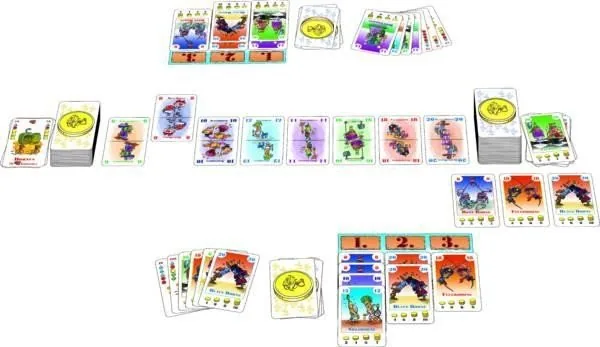
Setup at the start
of the game
Discard
pile
Draw
pile
Dollar
pile
Dollar
pile
Susanne
Bohnenfelder_Duell_160520.indd 1 20.05.16 08:12
Bohnenfelder_Duell_160520.indd 1
20.05.16 08:12
Bo(h)nus
card pile
Gift cards
Uwe
Discard
pile
Starting a new column Expanding an existing column

Chat with your AMIGO Bohnanza The Duel manual using AI

Get instant AI answers from your AMIGO Bohnanza The Duel manual

Ask anything about the AMIGO Bohnanza The Duel. Answers come from this manual, with the pages they are based on.

Ask a Question

0/1000

Do you recommend Bohnanza The Duel?

Yes No

Frequently Asked Questions

A

Check the Bohnometer on the top card of a field. It determines coins based on stack size.

Is this answer helpful?

A

No. You cannot rearrange bean cards in hand at any time during the game.

Is this answer helpful?

A

You must offer a new gift or bluff. The cycle repeats until someone accepts a bean.

Is this answer helpful?

A

Match bean sequences on fields to card symbols. Cash them in for points plus coins.

Is this answer helpful?

A

When the bean draw pile runs empty after the third phase of a turn.

Is this answer helpful?

A

Everyone gets three dedicated bean fields for planting cards throughout the session.

Is this answer helpful?

A

Accumulate the most bean ducats by harvesting card counts and fulfilling bonus card conditions.

Is this answer helpful?

M: QW-35-FL

Advantages and Disadvantages

Advantages

  • Deep strategic interaction between two players focuses on direct gameplay engagement.
  • Fast gameplay cycle with no downtime keeps the momentum continuous and exciting.
  • Bluffing adds psychological elements to the standard card matching mechanics significantly.
VS

Disadvantages

  • Limited to two players reduces group playability for larger social gatherings.
  • Hand order restriction limits tactical flexibility during critical planting phases.
  • Scoring depends heavily on specific bean sequences found late in the game.
M: QW-35-FL

Product Specification

Type

Card Game

Genre

Strategy

Players

2

Playtime

45 min

Age Recommendation

12 years and up

Author

Uwe Rosenberg

Publisher

Amigo

M: QW-35-FL

Product Description

Experience The Intense Bohnanza Duel

Welcome to the world of Bohnanza The Duel. This compact strategy game challenges two players to maximize their harvest effectively. The objective is simple yet demanding for every player. You must plant, manage, and harvest beans to collect the most coins. The game focuses on the classic card mechanics of the original series but condenses them into a personal battle. You handle three fields for planting throughout the session. Each player starts with a hand of cards. The setup is quick and ready to play in minutes. Players need to plan ahead carefully.

Game Flow And Mechanics

The gameplay consists of four distinct phases per turn. First, you plant one or two cards on your fields. You cannot rearrange your hand order. This restriction adds significant strategic weight. Second, you reveal three cards and offer a gift. Gifts can be real cards or bluffs. If you bluff, you risk losing coins if discovered. Your opponent decides to accept or reject the offer. If rejected, they offer a gift back. This cycle continues until an acceptance occurs. The gift phase creates tension.

Third, you plant all newly acquired cards. You must create valid stacks. Fourth, you draw new cards to replenish your hand. Bonus cards called Bohnuskarten grant extra value. They require specific bean sequences on your fields. You can cash them in anytime. Harvesting depends on the Bohnometer. This indicator shows coin earnings based on card count on a field. You must clear a field to plant again after some time. Bean counts vary by type.

Strategy And Scoring

Scoring happens at the end of play. The draw pile triggers the finish. Any bonus points can be collected after the final turn. Your hand cards do not count. Only your bean stash matters. Some bean varieties yield more coins than others. You must balance quantity with specific sequences for bonus cards. The rulebook details every scenario. Using the Bohnanza - The Duel Manual ensures fair play. Strategies evolve fast.

Final Notes

This version is designed for players aged 12 and older. It takes roughly 45 minutes to complete. The components are high quality and durable. The interactions are direct and constant. There are no waiting turns for opponents. This makes it ideal for competitive groups seeking depth. Ensure you follow the manual guidelines for setup. Enjoy the strategic tension of each harvest season. It is a great choice for home.

M: QW-35-FL

© Copyright 2026 Manual.ly