

Amica EKGCS 385900 Manual
PDF manual · 180 Pages
English



Quick check
Incorrect answer, please try again.
Chat with your Amica EKGCS 385900 manual using AI
Get instant AI answers from your Amica EKGCS 385900 manual
Ask anything about the Amica EKGCS 385900. Answers come from this manual, with the pages they are based on.
EKGCS 385900 Maintenance Schedule
Clean dust from air vents once or twice a year to ensure proper airflow and efficiency.
Defrost the appliance at least once or twice a year if ice accumulates. More frequent defrosting is required if excessive ice forms.
Wash the interior of the refrigerator and freezer compartments at least once a year to prevent odors and bacteria.
If clogged during automatic defrosting, carefully unclog the opening with the provided cleaning plug to prevent water accumulation.
Free maintenance reminders
Timed to your purchase date. Always free, unsubscribe anytime.
Ask a Question
Do you recommend EKGCS 385900?
Yes NoFrequently Asked Questions
The manual explains that temperature depends on ambient conditions, sunlight, door openings, and how much food you store. In most cases, a mid-range dial setting is optimal. If your home is warmer, you may need to turn the dial toward cooler positions. Also allow the fridge-freezer time to stabilize after changing settings, and avoid loading food before it reaches operating temperature.
Is this answer helpful?
The manual describes temperature zones created by natural airflow. The coldest area is directly above the vegetable drawers, ideal for delicate perishables such as fish, meat, poultry, egg-cream dishes, and fresh pre-labeled items around 4 C. The warmest zone is typically in the top door area, better for butter and cheese.
Is this answer helpful?
Freeze only high-quality items, ideally portioned for single use. Use tight, odorless packaging that resists air and moisture penetration. Keep fresh items away from already frozen goods, and place them in the marked freezing area. Reorganize items in the middle so they do not touch products that are not yet fully frozen. Do not exceed recommended fresh-load guidance from the manual.
Is this answer helpful?
The manual indicates that the fridge chamber has an automatic defrosting function. It also notes that the freezer chamber may be configured as no-frost on selected models, where freezer air circulation prevents ice and frost buildup. If your model is not no-frost, the manual advises periodic manual defrosting (at least once or twice a year, more often with heavier ice).
Is this answer helpful?
A common cause is a clogged water discharge opening, depending on the model. Another cause can be obstructed internal air circulation, where food or containers touch the rear wall and disrupt drainage. The manual recommends cleaning the discharge opening (as described in the defrosting section) and arranging shelves so items do not block airflow.
Is this answer helpful?
Check that power is connected and the temperature dial is above 0. If the dial is set correctly but temperature is still not low enough, review other causes from the manual: incorrect temperature setting, operation outside the climate range, placement in direct sun or near heat sources, too much warm food loaded at once, blocked airflow, frequent door openings, and an incorrectly seated door gasket.
Is this answer helpful?
Advantages and Disadvantages
Advantages

- Clear temperature dial guidance, including OFF/0 handling and how ambient conditions affect internal temperature.
- Practical storage zones for the fridge chamber to improve freshness and reduce waste.
- Strong freezing instructions: portioning, tight odorless packaging, and airflow-aware loading.
- Defrosting and cleaning steps explained to support hygiene, performance, and energy efficiency.
- Common troubleshooting checklist for temperature, drainage, airflow, and normal compressor noises.
Disadvantages

- Freezer defrosting may be manual on some configurations, requiring periodic effort to manage ice buildup.
- Loading and temperature changes require patience, such as waiting for operating temperature and allowing time for sensor/compressor response.
- Correct operation depends on proper ventilation, clearance from heat sources, and keeping the door gasket clean.
- Light replacement details vary by model, and some cases require qualified service.
Product Specification
Type
integrated (sliding hinge)
Energy efficiency class
E (A to G)
Old energy efficiency class
A++ (A+++ to D)
Energy consumption
208 kWh/year
Old energy consumption
191 kWh/year
Front color
white
Side color
white
Usable capacity refrigerator compartment
149.95 qt (top)
Usable capacity freezer compartment
63.40 qt (bottom)
Total usable capacity
213.45 qt
Star rating
4
Freezing capacity in 24h
5.73 lb
Storage time during power failure
12 h
Display
no
Special features
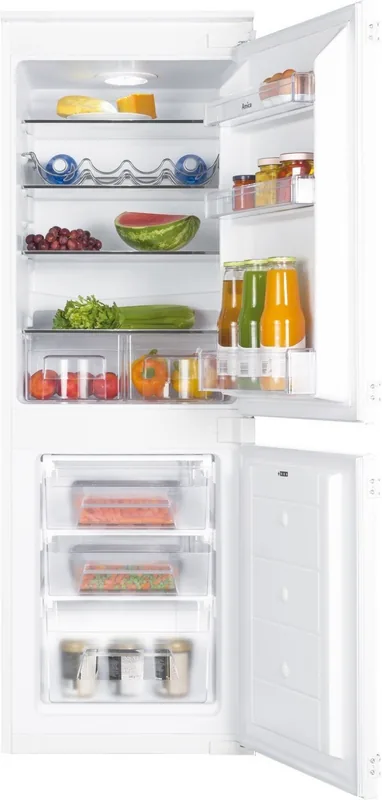
Vegetable compartment, LED lighting, Bottle rack
Climate class
N/ST
Noise level
40 dB(A)
Airborne acoustical noise emission class
C (A to D)
Door system
Door hinge right, reversible
Dimensions
21.26x61.81x21.26 in (WxHxD)
Installation dimensions
22.05x62.05x21.65 in (WxHxD)
Product Description
Amica EKGCS 385900 - Easy Living With the Amica EKGCS 385900 Manual
The Amica EKGCS 385900 is a household refrigerator-freezer designed to keep everyday food fresh and frozen reliably. This guide-inspired overview is built around the Amica EKGCS 385900 Manual, translating its practical instructions into simple, daily use tips. From safe installation to smarter storage habits, the focus is on stable temperatures, better organization, and efficient operation.
Built for correct temperature control
A key part of the experience is the temperature control dial. The manual explains how to switch the unit off, select warmer or cooler settings, and understand how room temperature, sunlight, door openings, and the amount of food affect the internal climate. It also highlights practical timing advice, such as letting the appliance reach operating temperature before loading fresh items.
Smarter storage, clearer zones, better freezing
Inside, naturally different temperature zones help you place food where it belongs. The coldest area above the vegetable drawers is recommended for delicate, highly perishable items like fish, meat, poultry, and egg-cream dishes. The warmer top part of the door is suggested for butter and cheese. For freezing, the manual emphasizes high-quality ingredients, portioning, tight odorless packaging, and airflow around frozen goods.
Defrosting and maintenance made manageable
The manual covers a range of defrosting approaches depending on the configuration: automatic defrosting in the fridge chamber, and an automatic no-frost style approach in the freezer chamber for selected models. Where manual defrosting applies, it explains why ice buildup increases energy use and how to defrost efficiently without overexposing food at room temperature.
Troubleshooting and long-term confidence
If something seems off, the guide provides common causes and fixes: temperature not reaching target levels, clogged drainage, blocked air circulation, or noises linked to leveling and normal compressor operation. It also includes instructions for service-minded maintenance and proper warranty handling.
Key results
- Set the dial based on ambient conditions, door frequency, and food load, aiming for stable mid-range performance.
- Use fridge temperature zones: cold zone for delicate perishables, door top for items like butter and cheese.
- Follow freezing best practices: tight, moisture-resistant packaging and controlled placement to protect quality.
- Keep airflow clear and maintain door seals to avoid warm spots and excessive compressor run time.
- Defrost correctly: reduce ice buildup to protect freezing performance and energy efficiency.
Notes
- Unplug the appliance before cleaning or maintenance.
- Do not refreeze partially thawed food, and never store carbonated drinks in the freezer.
- Ensure safe ventilation and use the climate range specified on the rating plate.
Search for 67,732 Manuals online


Type-in Brand or Model