
Adafruit RGB NeoPixel Jewel Manual
PDF manual · 7 Pages
English



Quick check
Incorrect answer, please try again.
Chat with your Adafruit RGB NeoPixel Jewel manual using AI
Get instant AI answers from your Adafruit RGB NeoPixel Jewel manual
Ask anything about the Adafruit RGB NeoPixel Jewel. Answers come from this manual, with the pages they are based on.
Ask a Question
Do you recommend RGB NeoPixel Jewel?
Yes NoFrequently Asked Questions
The NeoPixel Jewel operates from a nominal 5 V supply. Ensure a stable 5 V source and proper wiring to avoid voltage drop when chaining multiple jewels; decoupling capacitors near the power input are recommended.
Is this answer helpful?
Each pixel accepts a 24-bit GRB data word and forwards remaining data via its DOUT. Data is transmitted using a unipolar NRZ protocol at up to 800 Kbps; daisychaining is done by connecting DOUT of one pixel to DIN of the next.
Is this answer helpful?
Bit timing totals around 1.25 µs per bit with distinct high/low durations for '0' and '1' (approximately 0.3/0.9 µs for '0', 0.6/0.6 µs for '1'). A reset low period of at least ~50–80 µs is required to latch new frames.
Is this answer helpful?
Current depends on color and brightness. Each color channel can draw tens of milliamps at full brightness; a single RGB pixel may approach ~60–75 mA when all channels are at max. Plan power supplies and wiring accordingly for multiple jewels.
Is this answer helpful?
Yes. The Jewel uses the same timing and GRB data order as common SK6812/WS2812-style LEDs, so popular NeoPixel libraries and microcontroller platforms (Arduino, CircuitPython with appropriate drivers) are compatible.
Is this answer helpful?
The Jewel is great for wearables and indoor decorative use but is not inherently waterproof or rated for harsh outdoor exposure. For outdoor or wet environments, use appropriate sealing, conformal coating, or protective housings.
Is this answer helpful?
Advantages and Disadvantages
Advantages

- Compact 7-pixel cluster ideal for wearables and accent lighting.
- Integrated drivers with 256-level grayscale for smooth color mixing.
- Data shaping and forwarding enable long cascades with preserved signals.
- Simple DIN/DOUT chaining compatible with NeoPixel libraries and 5 V MCU boards.
- Built-in power-on reset and polarity protection increase robustness.
Disadvantages

- Requires a stable 5 V supply and careful power routing for large cascades.
- Sensitive to timing and reset requirements; improper timing causes flicker or errors.
- Higher current draw at full brightness; needs thermal and power consideration.
- Not intended for extreme industrial temperature ranges.
- Limited per-pixel resolution (7 pixels per jewel) for very high-detail displays.
Product Specification
Manufacturer
Adafruit
Type
1x LED module, individually addressable
Emitter
7x RGB LED (5050, 24-bit colors), individually addressable
Control Protocol
WS2812/SK6812, 800kb/s
Power Supply
5.0V, 7x 18.5mA (max. 7x 55mA per module)
Connection
Solder point
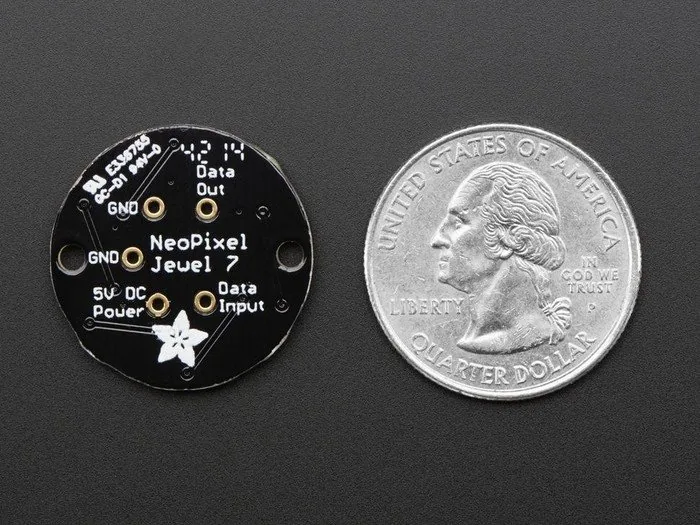
Dimensions (Diameter)
0.91 in
Product Description
Adafruit RGB NeoPixel Jewel Manual
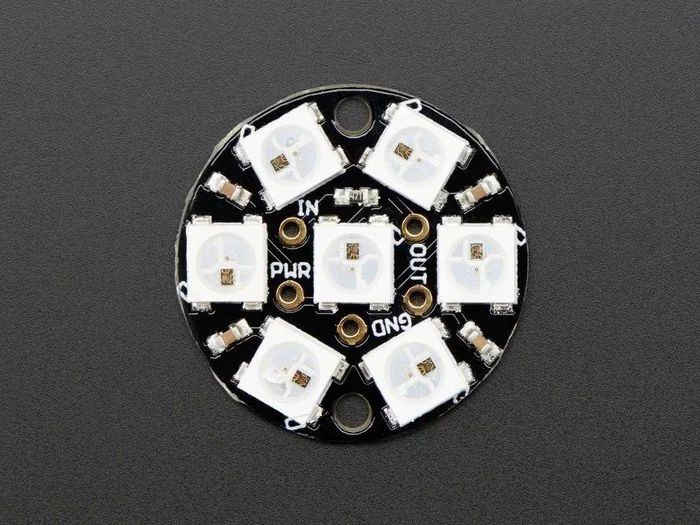
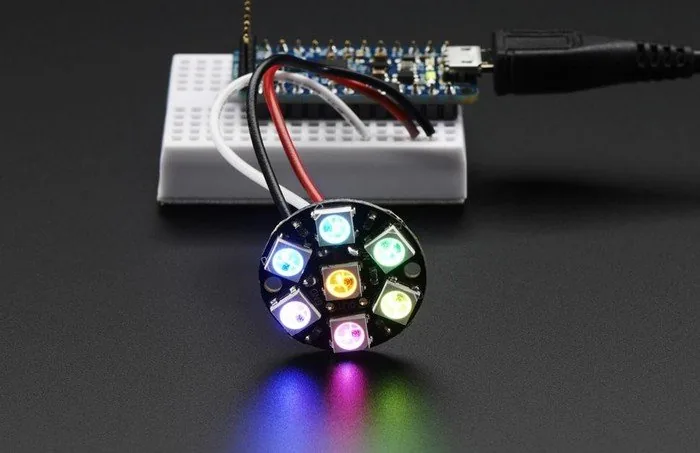
The Adafruit RGB NeoPixel Jewel is a compact, high-density ring of 7 individually addressable RGB LEDs built around SK6812/WS2812-style integrated LED pixels. Each jewel packs full-color control into a tiny SMD 5050 package, combining a constant-current driver, data latch, and PWM-based color control for smooth, bright, and power-efficient lighting effects. Designed for hobbyists, artists, and embedded designers, the NeoPixel Jewel is ideal for wearable projects, accent lighting, small displays, and decorative installations where space is limited but visual impact is important.
Inside each pixel is an integrated control circuit that accepts unipolar NRZ data at up to 800 Kbps and uses a 24-bit data structure per pixel (8 bits each for green, red, and blue). The on-chip data shaping and forwarding circuitry help preserve signal integrity across long cascades, supporting hundreds to thousands of pixels when paced correctly. The Jewel’s internal constant-current drivers and 256-level grayscale adjustment yield consistent color mixing, while built-in polarity and power-on reset protection improve robustness in real-world use.
Mechanically, the NeoPixel Jewel mirrors the common 5050 SMD form factor, making it easy to incorporate into PCB designs or sewable wearables. Typical electrical characteristics include a 5 V supply, PWM frequency in the kilohertz range, and low static power draw. Individual LED characteristics show distinct forward voltages and intensities for red, green, and blue channels, with careful internal calibration to balance perceived color output.
Practical applications span full-color pixel strings, shaped LED displays, accent lighting, and creative electronics. The Jewel’s compact cluster of seven pixels is especially useful for projects needing a bright, concentrated point of multicolor light without the fuss of larger strips or matrices. With simple DIN/DOUT chaining and standard NeoPixel libraries available for popular microcontrollers, getting dynamic animations, gradients, and reactive effects is straightforward.
Notes:
- Use a stable 5 V supply and consider power distribution if chaining many pixels; long runs require proper decoupling and wiring to prevent voltage drop.
- Respect the reset and timing requirements (data timings around 1.25 μs total per bit) to ensure reliable communication.
- The Jewel is not rated for extreme temperatures beyond typical consumer-grade ranges; observe manufacturer specs for storage and operation.
Search for 67,706 Manuals online


Type-in Brand or Model