
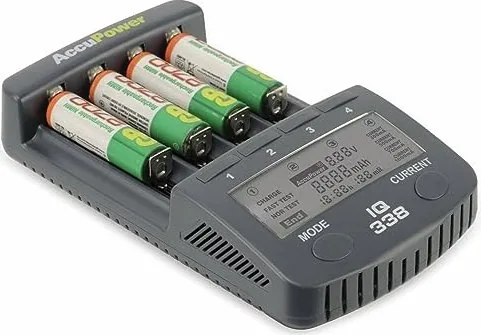
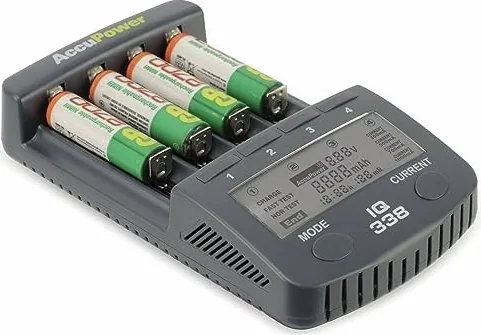

AccuPower IQ338 Manual
PDF manual · 7 Pages
English



Quick check
Incorrect answer, please try again.
Chat with your AccuPower IQ338 manual using AI
Get instant AI answers from your AccuPower IQ338 manual
Ask anything about the AccuPower IQ338. Answers come from this manual, with the pages they are based on.
Ask a Question
Do you recommend IQ338?
Yes No
Lukas Schreiber
9 months ago
How accurate and safe are the measured values and cutoff detection when charging NiMH or Li-ion (for example -dV detection at 300mA)? Can it overcharge or damage the cells if the displayed readings are not exact?

Manual.ly
9 months ago
The charger uses separate safety cutoffs per chemistry. For NiMH it relies on -dV/dt detection (termination depends on the selected charge current), which is designed to stop charging when the battery reaches a full state. The displayed voltage, internal resistance, and capacity are estimates and can vary somewhat from an external reference measurement. For Li-ion it uses fixed charge and protection cutoffs based on the selected battery type and program, so the charger is not intended to overcharge under normal use. For best safety, do not mix battery types, use the correct program for each cell, and follow the minimum discharge voltage recommendations from your battery manufacturer (do not discharge below specification).
Frequently Asked Questions
It supports rechargeable Li-Ion, NiMH, and NiCd cells in many common sizes, including AA, AAA, 18650, 14500, and other listed formats.
Is this answer helpful?
Yes. The charger has four independent slots, so each battery can be handled separately with its own settings when needed.
Is this answer helpful?
Charge Test discharges first, then charges the battery and stores both capacity values. Discharge Test charges first, then discharges for measurement, and finally charges again.
Is this answer helpful?
Yes. It displays capacity, voltage, internal resistance, current, and time, which together help you judge battery condition and performance.
Is this answer helpful?
Yes. The charger includes a 5V USB output rated at 1000 mA, which adds a useful extra charging option.
Is this answer helpful?
Use it indoors, keep it away from moisture and heat, place it on a non-flammable surface, and avoid leaving batteries unattended while charging.
Is this answer helpful?
Advantages and Disadvantages
Advantages

- Four independent slots let you charge and monitor multiple batteries separately.
- Supports a wide range of Li-Ion, NiMH, and NiCd battery sizes for flexible use.
- Charge Test and Discharge Test modes help measure capacity and battery condition.
- LCD readout shows voltage, current, elapsed time, capacity, and internal resistance.
- Adjustable charging current and a USB output add convenience and practical value.
Disadvantages

- Designed for indoor use only, so it is not suitable for wet or outdoor environments.
- Using the wrong battery type or charging current can reduce performance or safety.
- Charging should not be left unattended, which may feel inconvenient for some users.
- It does not support non-rechargeable batteries such as alkaline cells.
- The extra modes and settings may be more complex than a simple plug-and-charge charger.
Product Specification
Compatibility
Mignon AA, Micro AAA, Baby C, Sub-C, 10440, 14500, 16340, 17355, 17500, 17670, 18490, 18500, 18650, 22650, 26650
Charging bays
4x Cylindrical cell
Charging current
300-1,000 mA
Special features
USB output, Display
Dimensions
6.26x3.62x1.34in (LxWxH)
Weight
0.44 lb
Product Description
AccuPower IQ-338 Manual: A Smart Charger for Everyday Battery Care
The AccuPower IQ-338 is a practical choice for anyone who regularly works with rechargeable cells and wants more insight than a basic charger can provide. Built for Li-Ion, NiMH, and NiCd batteries, it supports many popular formats, including AA, AAA, 18650, 14500, and other commonly used cell sizes. Its four independent charging slots make it easy to handle multiple batteries at once without forcing every cell into the same setting.
What stands out in the AccuPower IQ-338 Manual is the flexibility of its operating modes. Standard Charge mode keeps things simple, while Charge Test and Discharge Test help users measure capacity and check battery condition over time. These functions are useful for anyone trying to refresh older cells, compare battery performance, or identify weaker batteries before they fail in a device.
The LCD display adds real value by showing live information such as voltage, capacity, elapsed time, internal resistance, charging current, and the status of each channel. That kind of feedback makes the charger feel more like a diagnostic tool than a simple power accessory. It is especially helpful for users who want to make informed decisions about charging speed and battery health.
Another advantage is the adjustable current selection. With charging options such as 300 mA, 500 mA, 700 mA, and 1000 mA, the IQ-338 can be matched to different battery needs. Lower currents are gentler, while higher currents save time when appropriate. The charger also includes a 5V USB output, which adds a small but useful extra function for daily use.
For hobbyists, flashlight users, photographers, and anyone managing many rechargeable batteries, this charger offers a balanced mix of convenience, safety awareness, and useful data. It is best used indoors on a stable, non-flammable surface, with careful attention to battery type, temperature, and charging current. In short, the IQ-338 is designed for users who value control, visibility, and dependable charging performance.
Notes
- Use only compatible rechargeable batteries.
- Match the current to the battery specification.
- Keep the charger dry and unattended use to a minimum.
- Unplug it when not in use.
Search for 67,706 Manuals online


Type-in Brand or Model
Jonas Weber
9 months ago
How reliable is the -DeltaV cut-off at 300 mA for NiMH, and are the voltage/internal resistance readings and Li-ion discharge cutoff accurate enough to prevent overcharging or cell damage?
Manual.ly
9 months ago
The charger uses -DeltaV detection plus internal safety limits (such as time and cutoff logic) to terminate NiMH charging when a charge-stop condition is reached. While the displayed voltage, capacity, and internal resistance are useful indicators, exact readings can differ from other chargers and lab meters, especially at lower currents (for example 300 mA). For Li-ion, the device applies a defined discharge termination threshold as specified for Li-ion mode to help avoid over-discharge. To reduce risk: use the correct battery chemistry and program, set a charge current that matches the cell manufacturer specs, and charge only cells that meet the device's supported sizes/chemistries. If your results look abnormal, do a test with known cells and confirm settings.