
AccuPower IQ328+ Manual
PDF manual · 7 Pages
English



Quick check
Incorrect answer, please try again.
Chat with your AccuPower IQ328+ manual using AI
Get instant AI answers from your AccuPower IQ328+ manual
Ask anything about the AccuPower IQ328+. Answers come from this manual, with the pages they are based on.
Ask a Question
Do you recommend IQ328+?
Yes NoFrequently Asked Questions
The charger supports Li-Ion cells in various sizes like 18650, 26650, and 14500. It also handles NiCd and NiMH batteries including AA, AAA, and C sizes. Always ensure voltage matches 3.6V-3.7V for Li-Ion and 1.2V for NiCd/NiMH.
Is this answer helpful?
Yes, all four channels are independent. You can load different cells into different slots. Ensure you set the correct current and mode for each channel manually before or after insertion.
Is this answer helpful?
Use Charge Test to measure capacity stored during a cycle or Discharge Test to determine current usable capacity. The LCD screen displays the measured mAh after the test cycle completes.
Is this answer helpful?
No, it is designed for dry closed indoor environments only. Do not operate outdoors due to risk of water damage or high humidity. Avoid placing it on flammable surfaces like carpets indoors.
Is this answer helpful?
The unit has a temperature control cutoff at 50 degrees Celsius. This protects the battery and the charger from overheating risks. Ensure good ventilation around the device during operation.
Is this answer helpful?
Use a dry soft cloth to clean the housing. Never use solvents or liquids. Disconnect power from the outlet before cleaning. Do not disassemble the unit to avoid electrical shock.
Is this answer helpful?
Advantages and Disadvantages
Advantages

- Four independent channels allow simultaneous charging of different battery types efficiently.
- LCD display provides real-time data on voltage, capacity, resistance, and charging status.
- Supports wide range of Li-Ion and NiCd/NiMH batteries with adjustable current per channel.
- Includes specific testing modes like Charge Test and Discharge Test for health analysis.
- Features built-in temperature control to prevent overheating during operation safely.
Disadvantages

- Requires a specific 12V 2A power adapter which may not be standard for all users.
- Generates significant heat during charging which requires non-flammable surface placement.
- Strict indoor use only policy prevents operation in wet or outdoor environments safely.
- Complex testing modes might be confusing for beginners unfamiliar with battery chemistry.
- Unauthorized repairs or changes to the device void the warranty completely.
Product Specification
Compatibility
AA, AAA, C, Sub-C, 10440, 14500, 16340, 17355, 17500, 17670, 18490, 18500, 18650, 22650, 26650
Charging Slots
4x Cylindrical Cells
Charging Current
300-1000mA
Features
Display
Dimensions
6.26x3.62x1.46in (LxWxH)
Product Description
Mastering Power with the AccuPower IQ-328+
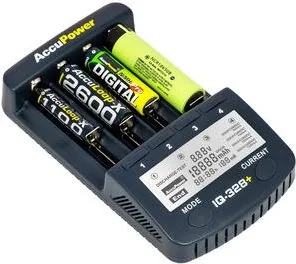
The AccuPower IQ-328+ offers a robust solution for maintaining rechargeable cells. This intelligent charger is designed for users who demand precision and safety in their power management routine. It offers four independent charging channels, allowing you to power up multiple devices simultaneously without compromising performance. This capability makes it ideal for teams or individuals with extensive battery inventories. Always consult the AccuPower IQ-328+ Manual for detailed safety protocols before starting any operation.
Unmatched Battery Compatibility
Users can charge a wide variety of battery types including Li-Ion configurations such as the 26650, 18650, and 14500 models. Additionally, it supports NiCd and NiMH batteries in standard sizes like AA, AAA, and C. This versatility makes it a staple for technicians and hobbyists alike. The device ensures that each channel operates independently, meaning you can mix different chemistries if settings are adjusted correctly. Verify all voltage requirements to prevent damage to your expensive cells.
Advanced Display and Testing Modes
The LCD screen provides live data including voltage, capacity, time, and internal resistance. Three primary modes are available for selection: standard charge for routine replenishment, Charge Test to measure incoming capacity quickly, and Discharge Test for evaluating the overall health of the battery. These tests help refresh old cells and determine their usable life span effectively. The display shows clear status indicators for channel numbers and current flow.
Operational Controls and Safety Protocols
Safety is paramount when handling electrical devices. The device features intuitive button controls for selecting charge current and changing modes. Users must press buttons carefully to avoid accidental program stops. If needed, a long press on the Mode button interrupts the current process. The unit includes temperature control to prevent overheating above 50 degrees Celsius. Users must avoid placing the unit on flammable surfaces such as carpet or paper. It is also important to keep the device in a dry indoor location away from weather elements like rain or snow. Input options include AC power supplies ranging from 100 to 240 volts or a DC connection at 12 volts and 2 amps.
Maintenance and Disposal Guidelines
Maintenance involves simple cleaning with a dry soft cloth, ensuring no liquids enter the unit. Never use abrasive cleaners or solvents. The warranty becomes void if unauthorized modifications are made. When the product reaches its end of life, proper disposal is required. Do not throw it in regular trash. Electronic components contain chemicals that can harm the environment. You should take the charger to a designated collection point for electronic waste. Adhering to these rules ensures longevity and environmental safety for your equipment. Remember to check local regulations for proper recycling of the power brick as well.
Search for 67,706 Manuals online


Type-in Brand or Model