
ABB ES/S X.1.2.1 Manual
PDF manual · 108 Pages
English



Quick check
Incorrect answer, please try again.
Chat with your ABB ES/S X.1.2.1 manual using AI
Get instant AI answers from your ABB ES/S X.1.2.1 manual
Ask anything about the ABB ES/S X.1.2.1. Answers come from this manual, with the pages they are based on.
Ask a Question
Do you recommend ES/S X.1.2.1?
Yes NoFrequently Asked Questions
It controls electro-thermal valve drives, motor-driven actuators, and general lighting loads. Outputs handle resistive currents up to one ampere with surge protection capabilities built directly into the circuitry design.
Is this answer helpful?
The unit requires a 24 to 230 volt AC or DC supply for outputs while the KNX bus provides control voltage. Separate supply terminals exist for combining different voltage levels on paired outputs as needed.
Is this answer helpful?
Yes, front panel buttons enable manual control independent of KNX communication. This feature is useful for testing connections or overriding system commands during emergencies or maintenance periods.
Is this answer helpful?
Automatic adjustment ensures accuracy by moving the valve to a zero position periodically. This compensates for drift caused by wear or changes in ambient conditions over time significantly improving long term performance.
Is this answer helpful?
Settings define whether the output retains its state, opens, or closes upon recovery. Configurable parameters allow engineers to specify behavior for critical infrastructure during unexpected power loss events happening unexpectedly.
Is this answer helpful?
Programming uses ETS software for assigning addresses and setting parameters logically. Physical addresses are assigned by pressing buttons on the device until LEDs indicate successful confirmation.
Is this answer helpful?
Advantages and Disadvantages
Advantages

- Semiconductor outputs ensure high reliability and longevity by eliminating mechanical wear found in traditional relay systems.
- Flexible operation modes support both lighting switches and precision valve drive control within a single device unit.
- Integrated safety features include overload protection and configurable priority levels for critical interventions.
- Local manual operation buttons allow control access even when network connectivity is temporarily lost or absent.
- Modular design fits standard distribution boards with multiple width options to suit specific capacity requirements.
Disadvantages

- Initial commissioning requires specialized Engineering Tool Software knowledge to configure parameters correctly.
- Dependency on KNX bus voltage affects availability of certain functions during power restoration events.
- Complex parameterization may lead to longer setup times compared to simpler legacy devices in some cases.
- Physical dimensions limit installation in very tight enclosures where space is extremely restricted heavily.
Product Specification
Type
Actuator
Standard
KNX
Function
Switch actuator (on/off)
Topology
Bus
Special Features
IP20
Product Description
Intelligent Automation Solutions with ABB ES/SX.1.2.1
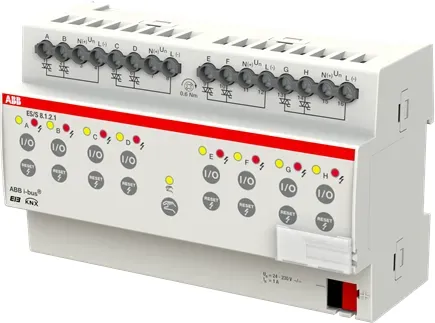
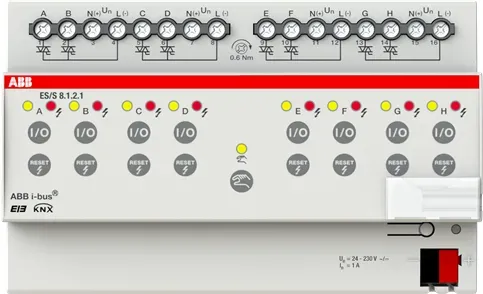
Modern building management requires reliable components that handle complex tasks effortlessly. The ABB ES/SX.1.2.1 acts as a central hub for controlling various loads like lights or heating valves. Its semiconductor outputs ensure longevity by eliminating mechanical wear common in older relay-based systems. Compatibility with KNX bus architecture allows seamless integration into larger smart building networks worldwide. Users appreciate the flexibility offered by adjustable parameter sets managed through professional engineering tools. This device supports a wide voltage spectrum ranging from twenty-four to two hundred thirty volts providing versatility for different regional standards.
Flexible Configuration Options
Engineers can choose between switch actuator mode or advanced valve drive operations depending on project needs. Pulse-width modulation enables precise control for thermoelectric drives while digital switching suits simple lamp applications. Each channel provides protection against overload situations automatically ensuring safe operation under varying loads. Status indicators illuminate clearly to guide installers during setup procedures without guesswork. Configuration information aligns with standard ABB ES/SX.1.2.1 Manual specifications helping teams optimize system performance effectively during installation phases. You can combine outputs to match specific load characteristics easily. Parameterization covers general settings, manual operation controls, and specific output behaviors individually. Logic functions allow complex dependencies between sensors and actuators without needing extra hardware boxes. Scene functions store preset states for rapid recall by users daily.
Safety and Reliability
Critical functions prioritize safety using multiple levels of intervention capabilities. Bus voltage recovery settings define behavior after power interruption events occur unexpectedly. Manual override buttons permit local operation even if network signals are unavailable temporarily. These features reduce downtime and maintain tenant comfort during technical issues. Enclosure ratings meet industry standards for indoor electrical installations safely. Priority settings allow urgent commands to bypass standard logic flows immediately. Monitoring telegrams keep track of device health continuously across the entire network topology.
Physical Design and Dimensions
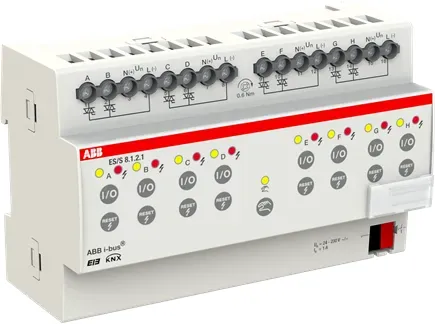
Compact form factors fit standard DIN rails within distribution boards easily. Width options vary based on output requirements with four or eight space units available for selection. Depth measurements stay consistent for compatibility with existing mounting solutions used previously in facilities globally. Weight considerations allow single-person handling during initial placement in ceiling or wall spaces comfortably. Grey plastic housings blend professionally into modern architectural designs everywhere without clashing visually. Mounting depth remains fixed at sixty-four point five millimeters simplifying spatial planning significantly.
Note: Verify all connection points before energizing the system to prevent component damage occurring early. Monitoring thresholds helps identify potential faults early during routine inspections regularly scheduled. Continuous updates ensure firmware maintains peak efficiency throughout the product lifecycle always maintained by manufacturer support. Proper grounding reduces interference noise affecting signal transmission quality consistently.
Search for 67,706 Manuals online


Type-in Brand or Model