
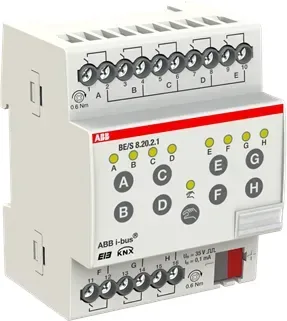
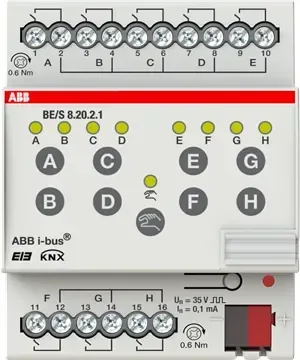
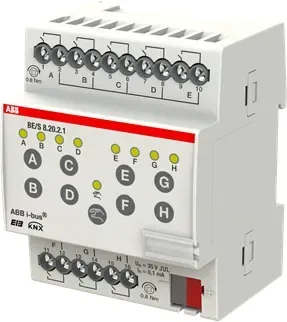
ABB BE/S 8.20.2.1 Manual
PDF manual · 160 Pages
English



Quick check
Incorrect answer, please try again.
Chat with your ABB BE/S 8.20.2.1 manual using AI
Get instant AI answers from your ABB BE/S 8.20.2.1 manual
Ask anything about the ABB BE/S 8.20.2.1. Answers come from this manual, with the pages they are based on.
BE/S 8.20.2.1 Maintenance Schedule
If dirty, clean with a dry cloth or one dampened with soapy solution. Never use corrosive agents.
The device is maintenance-free. No repairs should be carried out by unauthorized personnel if damage occurs.
Ask a Question
Do you recommend BE/S 8.20.2.1?
Yes NoFrequently Asked Questions
It connects up to eight conventional potential-free contacts to a KNX system. Typical uses include push-buttons, switches, window contacts, fault contacts, pulse meters, lighting controls, blind controls, and scene triggers.
Is this answer helpful?
Yes. Each of the eight channels can be configured independently in ETS. One channel may operate lighting, another may control a blind, while others can report alarms, send values, trigger scenes, or count pulses.
Is this answer helpful?
No. The BE/S8.20.2.1 is designed for potential-free contacts and provides its own internally generated pulsed sensing voltage. Applying external voltage to the binary inputs is not permitted.
Is this answer helpful?
The unit requires 4TE of DIN-rail space, equal to 72 mm in width. It is designed for mounting on a standard 35 mm DIN rail inside a distribution board.
Is this answer helpful?
Yes. Front-panel buttons can simulate the state of each binary input. This is useful during commissioning or troubleshooting when connected switches or contacts are not yet available.
Is this answer helpful?
ETS is required to assign the physical address, configure channel functions and parameters, link group addresses, and download the configuration to the KNX binary input.
Is this answer helpful?
Advantages and Disadvantages
Advantages

- Eight independently configurable channels support diverse KNX input tasks in one 4TE DIN-rail device.
- Supports switching, dimming, blind control, scenes, value transmission, sequences, multiple presses, fault reporting, and pulse counting.
- Manual channel simulation and front LEDs simplify commissioning, functional checks, and troubleshooting.
- Internal pulsed sensing voltage allows direct use with potential-free contacts without a separate input supply.
- ETS parameters provide debounce, minimum signal duration, cyclic sending, blocking, and manual-mode control.
Disadvantages

- Only suitable for potential-free contacts; external voltage on the input terminals is prohibited.
- Configuration requires ETS and KNX commissioning knowledge.
- The 4TE width may require more distribution-board space than smaller four-channel inputs.
- Manual operation can be restricted by configuration, which may limit local testing in some installations.
- Designed for protected indoor distribution-board installation with IP20 protection.
Product Specification
Type
Sensor
Standard
KNX
Function
Binary input
Topology
Bus
Dimensions
2.83 x 3.54 x 2.52 in
Special features
IP20
Product Description
ABB BE/S8.20.2.1 KNX Binary Input 8-Channel, 20V, 4TE REG. Manual
The ABB BE/S8.20.2.1 KNX Binary Input 8-Channel, 20V, 4TE REG. Manual is a useful reference for integrating conventional potential-free contacts into an ABB i-bus KNX automation system. This eight-channel binary input is designed for distribution-board installation and creates a flexible bridge between standard push-buttons, switches, signaling contacts, and intelligent KNX control functions.
Eight inputs for adaptable building control
Each of the eight independent inputs can be configured separately, allowing one device to support multiple control tasks within the same installation. It is suitable for reading dry contacts with an internally generated pulsed sensing voltage of 35 V. External voltage must not be connected to these inputs, making correct wiring and contact selection essential.
The compact 4TE REG housing mounts on a standard 35 mm DIN rail and measures 90 x 72 x 67.5 mm. Its practical panel-mounted design makes it a strong choice for residential, commercial, and functional buildings where centralized KNX control is required.
Flexible functions per channel
The BE/S8.20.2.1 is more than a simple contact interface. Every channel can be assigned a specific operating mode through ETS configuration. Available functions include switching and fault indication, switching and dimming, blind or shutter operation, value transmission, forced control, scene control, switching sequences, multiple push actions, and pulse counting.
This flexibility supports many everyday automation needs. Conventional wall controls can operate lights or dimmers, contacts can trigger blind movement, and dry alarm contacts can report status conditions. Pulse-counting functions can also be used for monitoring meter pulses or button activations. Short and long presses, debounce times, minimum signal durations, cyclic transmissions, and blocking functions provide additional control over how each input reacts.
Manual operation and clear status indication
Manual controls on the front of the unit help simplify testing and commissioning. Individual channel buttons can simulate contact states even when field contacts are not yet connected. Yellow LEDs show the configured input state, while a dedicated manual-operation indicator identifies whether the device is operating locally or through KNX.
Manual mode can be enabled, blocked, or automatically reset after a selected period. This provides a practical balance between local testing access and controlled building operation. LED behavior can also be configured as normal, inverted, or locked to match the required application.
Installation and configuration notes
The unit is powered from the KNX bus and consumes up to 7 mA. It supports cable lengths up to 100 m with 1.5 mm2 conductors and is intended for use in enclosed distribution boards. ETS is required for assigning the physical address, selecting functions, and loading parameters.
Note: Installation and commissioning should be completed by qualified electrical professionals. Protect the unit from moisture, dirt, damage, and unsuitable environmental conditions.
Note: The BE/S8.20.2.1 is intended for potential-free contacts only. Do not apply an external voltage to its binary input terminals.
Search for 67,706 Manuals online


Type-in Brand or Model