
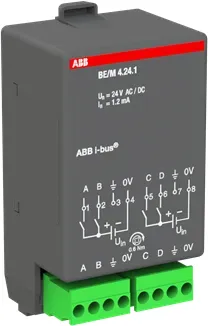
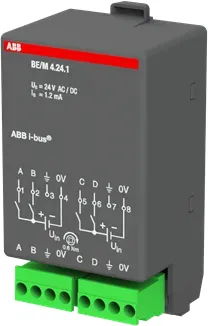
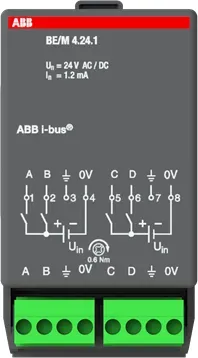
ABB BE/M 4.24.1 Manual
PDF manual · 47 Pages
English



Quick check
Incorrect answer, please try again.
Chat with your ABB BE/M 4.24.1 manual using AI
Get instant AI answers from your ABB BE/M 4.24.1 manual
Ask anything about the ABB BE/M 4.24.1. Answers come from this manual, with the pages they are based on.
Ask a Question
Do you recommend BE/M 4.24.1?
Yes NoFrequently Asked Questions
The module features four independent binary inputs available for monitoring various contacts. Each input can be programmed separately to perform different functions such as switching, dimming, or counter operations depending on system configuration.
Is this answer helpful?
It is designed to read 12 V or 24 V AC/DC signals. An external power source is required for the signal scanning process as this model differs from the 230 V version which supplies its own voltage.
Is this answer helpful?
Yes, the device supports shutter sensor functions. It manages blinds through up to eight preset responses based on short or long actuator commands received locally, enabling flexible operation modes.
Is this answer helpful?
Stable operation is ensured during voltage failures, restoring correct states once power returns safely. Object values update accordingly depending on specific function parameters set during initial configuration.
Is this answer helpful?
Configuration requires ETS2 version 1.3a or higher for full compatibility assurance. This tool allows comprehensive parameterization of debounce times, signal durations, and assigned functional roles.
Is this answer helpful?
Yes, an external 12 or 24 V power source is needed for signal scanning. Unlike other versions handling higher voltages internally, this unit relies on supplemental power adapters for correct operation.
Is this answer helpful?
Debounce times are fully customizable to filter out unwanted electrical noise during transmission sequences. Settings allow specific delays after detecting a signal edge to validate the input state before processing.
Is this answer helpful?
Advantages and Disadvantages
Advantages

- Supports diverse functions including dimming, shutter control, and pulse counting efficiently.
- Easy snap-in installation eliminates complex wiring requirements within base units.
- Configurable debounce times minimize false triggering from electrical interference reliably.
- Compact dimensions save valuable space inside distribution cabinets significantly.
Disadvantages

- Requires external 12 or 24 V power source unlike higher voltage internal supply models.
- Programming mandates specific ETS2 software versions ensuring system compatibility strictly.
- Limited exclusively to Room Controller Base Unit slots restricting standalone usage.
- Maximum telegram rate limits may restrict rapid response applications under heavy load.
Product Specification
Type
Sensor
Standard
KNX
Function
Binary input, Shutter control
Topology
Bus
Dimensions
1.65x1.93x3.66in
Features
IP54
Product Description
Optimized Building Automation with KNX Integration
Modern building automation relies on precise signal processing to ensure optimal performance across various electrical systems. The ABB BE/M4.24.1 KNX Binary Input Module 4-fold, 12V/24V Manual provides essential information for integrating these devices into intelligent infrastructure. Engineers utilize this component to monitor contacts such as conventional switches and push buttons effectively. Installation involves snapping the unit into a module slot of the Room Controller Base Unit, establishing immediate connectivity within distributed control architectures.
This specific model operates at lower voltages compared to mains powered alternatives found in larger networks. It requires an external 12 or 24 V AC or DC power source for signal scanning purposes, distinguishing itself from versions handling higher voltages internally without supplemental power adapters. Each module contains four independent inputs capable of extensive programming flexibility. Users assign functions like lighting control, blind operation, or pulse counting through the dedicated EIB Tool Software interface on their computer workstation. Comprehensive parameterization allows customization of debounce times and minimum signal durations to filter out unwanted electrical noise during transmission sequences.
Functional versatility defines this hardware solution for residential or commercial sectors globally. Inputs support operations ranging from simple switching commands to complex scene recalls and predefined switching sequences. Dimming capabilities enable stepwise adjustment or continuous fading of luminaires using single-button interfaces for user convenience. Shutter sensors manage blinds through up to eight preset responses based on short or long actuator commands received locally. Value transmission lets users send temperature readings or fixed data types upon contact closure events for real-time analytics. Safety protocols ensure stable operation during unexpected voltage failures restoring correct states once power returns safely.
Reliability remains a top priority in demanding commercial installations everywhere today. The housing is designed for DIN rail mounting logic with snap-on capability directly into the controller chassis securely. Dimensions remain compact at approximately 49 by 42 by 93 millimeters fitting neatly into crowded switchboards without taking excessive room. Certification ensures compliance with EMC and low voltage guidelines for safe deployment worldwide without regulatory hurdles during inspections. Maintenance is simplified through accessible screw terminals allowing flexible cable connections up to 2.5 square millimeters fine stranded wire easily.
Key Implementation Notes
Programming requires ETS2 version 1.3a or higher for full compatibility assurance. Always verify external power stability before finalizing wiring connections for safety. Grounding is essential for protective conductor PE connection integration throughout system. Proper labeling helps distinguish between active inputs during troubleshooting phases effectively. Counter functions include differential counters measuring consumption values independently from absolute totals. This feature facilitates daily monitoring trends without resetting the primary register constantly over extended periods. Overrun limits trigger overflow alerts when thresholds are exceeded programmatically for system health. Telegram rate limitations prevent network congestion by restricting burst transmissions during high activity periods consistently. Cyclical sending options allow remote status monitoring for critical infrastructure elements continuously online. Weight stays minimal at 0.06 kg per unit reducing structural load on rack assemblies significantly.
Search for 67,706 Manuals online


Type-in Brand or Model