
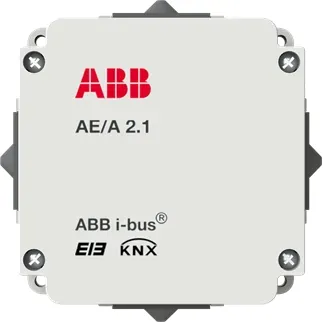
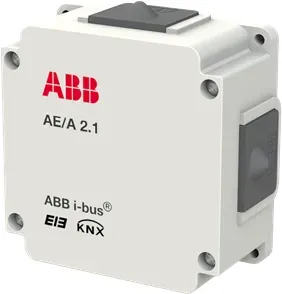

ABB AE/A 2.1 Manual
PDF manual · 68 Pages
English



Quick check
Incorrect answer, please try again.
Chat with your ABB AE/A 2.1 manual using AI
Get instant AI answers from your ABB AE/A 2.1 manual
Ask anything about the ABB AE/A 2.1. Answers come from this manual, with the pages they are based on.
Ask a Question
Do you recommend AE/A 2.1?
Yes NoFrequently Asked Questions
The unit accepts voltage signals ranging from zero to ten volts, current loops such as four to twenty milliamps, resistance values up to one thousand ohms, and various temperature sensors like PT100, PT1000, and KTY models. Potential free contacts are also supported.
Is this answer helpful?
No, the device operates on bus power ranging from twenty-one to thirty-two volts DC. It draws less than ten milliamperes and does not need an additional power supply, simplifying wiring connections significantly.
Is this answer helpful?
Yes, you can set and modify threshold limits remotely via the bus. The communication objects allow changing upper and lower boundary values without physical access to the device, enabling dynamic system tuning.
Is this answer helpful?
Upon startup, the analog circuit performs an automatic background calibration taking approximately one hour. This process does not interrupt normal function and saves results to ensure immediate accuracy on subsequent power cycles.
Is this answer helpful?
Configuration requires ETS version three or higher. If using older ETS two, version one point three a is required. The application program handles parameter assignment for sensor types and calculation modules.
Is this answer helpful?
Yes, the casing meets IP54 standards indicating protection against dust and water jets. Users must install supplied blind plugs to maintain this rating and prevent moisture damage to internal electronics.
Is this answer helpful?
Installers must follow DIN VDE regulations for accessibility and maintenance. Equipment must only be operated within specified temperature ranges to avoid damage. Unauthorized repairs void warranty coverage.
Is this answer helpful?
Advantages and Disadvantages
Advantages

- Supports dual analog inputs for voltage, current, and resistance signals simultaneously.
- Automatically calibrates on power-up to ensure measurement accuracy without manual setup.
- Bus-powered operation eliminates the need for auxiliary power supplies.
- Configurable thresholds allow remote adjustment of upper and lower limits.
- Includes calculation objects for mathematical operations between inputs.
Disadvantages

- Requires ETS software for configuration which adds dependency.
- Surface mount design may not fit every concealed installation requirement.
- Specific sensor wiring rules apply to avoid lead resistance errors.
- Limited number of calculation objects compared to complex controllers.
- IP54 rating requires careful sealing of unused cable entries.
Product Specification
Type
Sensor
Standard
KNX
Function
Analog input
Topology
Bus
Dimensions
2.83x3.54x2.54in
Features
IP20
Product Description
Exploring the ABB AE/A2.1 KNX Analog Input Solution
In today's landscape of intelligent building technology, managing sensor data efficiently is paramount. Complex installations require reliable interfaces to handle real-time information from diverse sources. The ABB AE/A2.1 KNX Analog input 2-fold stands out as a versatile tool designed for professionals seeking precision in automation tasks. It enables the collection and processing of two separate analog signals, facilitating control over heating systems, ventilation dampers, or liquid levels in tanks. By integrating into the KNX ecosystem, this device supports energy-efficient operations while maintaining high safety standards for occupants.
Technical Capabilities and Flexibility
Hardware specifications highlight durability with an IP54 rating suitable for various indoor environments. The unit measures 117 mm by 117 mm with a slim profile, ensuring easy wall mounting using screw fixtures. Connections utilize green screw terminals for both power and sensors. Electrical supply ranges from 21 to 32 volts DC drawn directly from the bus, removing the necessity for external transformers. Signal support covers voltages up to 12 volts, currents up to 25 milliamperes, and resistances for standard temperature probes. Users can configure parameters using ETS3 software to match specific sensor characteristics found in the market today.
Operational Efficiency and Maintenance
Automatic calibration runs silently after initial power-up to guarantee accuracy without disrupting normal function. Filter settings allow smoothing of data through averaging techniques that reduce noise interference. Administrators can define thresholds for alert systems when values exceed safe operating limits remotely. Calculation modules compare inputs mathematically to derive derived metrics useful for advanced control logic. Status bytes provide insight into operational health such as sensor breaks or ongoing calibration states.
Implementation Considerations
Safety protocols mandate adherence to DIN standards during installation. Cables must be protected against moisture ingress using supplied plugs to maintain protection ratings. Documentation guides electricians through detailed wiring diagrams showing correct termination procedures. Compliance with EN 50090 standards ensures interoperability with other KNX participants globally. Regular cleaning with dry cloths suffices for maintenance as the housing resists dust accumulation effectively. Proper selection of sensor wires minimizes lead errors affecting final temperature readouts.
Strategic Advantages for Projects
Choosing this module simplifies project planning due to extensive parameter options available within the application interface. Engineers gain the ability to mask certain measurement curves or shift baselines dynamically. Remote access to threshold values allows adjustments without visiting the site physically. Data transmission formats include integers and floating-point values for maximum compatibility. Long-term reliability stems from robust construction designed to withstand fluctuating temperatures between minus 20 degrees and plus 70 degrees Celsius during operation.
Search for 67,706 Manuals online


Type-in Brand or Model